Protecting main
protect_main blocks writes to branching-supported models made outside a branch. It is off by default, because turning it on by default would break an existing install the moment the plugin is added.
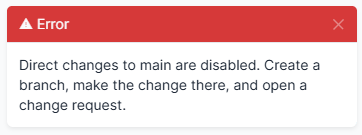
A refused write keeps the user on the form they were filling in, with the reason and what to do instead:
Direct changes to main are disabled. Create a branch, make the change there, and open a change request.
A delete shows the same message as an error toast, and the REST API returns 400 with it as detail. The refusal is raised as NetBox's AbortRequest, which is the mechanism a signal receiver is given for exactly this. Raising PermissionDenied instead produced a bare Access Denied page with the explanation discarded, which reads like a misconfigured permission rather than a deliberate policy.
Users holding netbox_change_control.bypass_policy are exempt; see granting the exemptions. Writes with no request context, such as migrations, scripts and background jobs, are allowed: they are not interactive edits.
Note
Superusers hold every permission, so a superuser is never blocked.
Protecting only part of NetBox
The commercial product's equivalent is all-or-nothing. In practice a team often wants branch discipline on one risky area without forcing every IPAM edit through review.
protect_main_scope takes app_label.modelname or app_label.* entries:
To protect specific models only:
An entry naming one model does not protect its siblings in the same app. An empty list protects every branching-supported model.